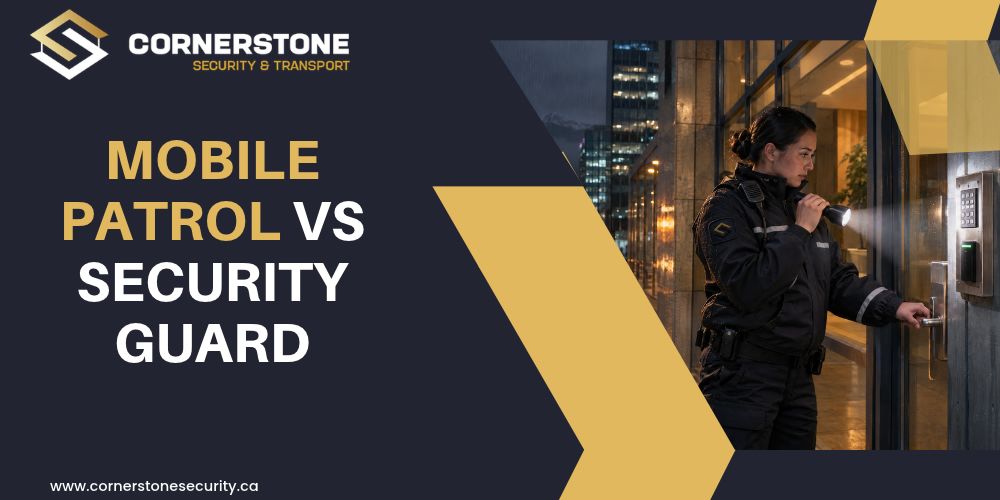
Mobile patrol services get treated as the budget version of a security guard, and that assumption leads a lot of property managers to pay for the wrong one. Some put a guard on a site that only needed checking a few times a night. Others sign up for the cheapest patrol route they can find, then learn after a break-in that nobody ever got out of the car.
The two services do different jobs. A guard covers one place for every hour you pay for. A patrol covers your property in short visits, at times nobody outside can predict, and leaves a record of each one.
Before we get into cost or which one your property needs, it’s worth being clear on what each one actually does on a shift.
Key Takeaways
- A security guard stays on one site for the full shift. A mobile patrol officer covers several sites on a route and spends minutes at each one.
- A guard around the clock is 168 hours a week. At the BC median guard wage, that’s over $16,000 a month in wages alone, before a security company adds anything.
- Patrols suit properties that sit empty after hours. Guards suit places where people need to be let in, helped, or turned away all day.
- A patrol is only as good as what it records. Ask for a report from every visit.
- Plenty of properties don’t need to choose. A guard during the busy hours and a patrol overnight is a common setup.
What does a mobile patrol security officer do?
A mobile patrol officer drives a route between properties and stops at each one on a schedule, at random times, or when an alarm goes off. On every stop they get out and walk the site. They check doors, gates, and locks, look for signs of forced entry, ask anyone who shouldn’t be there to leave, and note anything that’s changed since the last visit, like a light that’s out, a cut fence, or a loading door left open.
Then they write it up. Every visit should leave a record of when the officer arrived, what they checked, what they found, and when they left. That record is most of what you’re paying for. A patrol you can’t verify is just a car that may or may not have driven past.
A lot of patrol work is also alarm response. When your alarm trips at 2 a.m., someone has to go and look. If that someone is you, you’re the one standing in a dark parking lot deciding whether to go inside. A patrol officer attends instead, checks the property, and calls the police if there’s actually something to call them about.
What’s the difference between a mobile patrol and a security guard?
The difference is time on site. A security guard is posted to one property for a full shift. They control who comes in, watch the cameras, help visitors, and deal with whatever happens in front of them, because they’re always there.
A mobile patrol officer is on your property for a few minutes at a time, several times a night, and spends the rest of the shift on other sites along the same route. You’re sharing that officer’s night with other properties, which is exactly why a patrol costs less.
So the real question is whether your property needs a person present, or whether it needs to be checked. A condo lobby where residents and couriers come and go all evening needs a person. A warehouse that’s locked at 6 p.m. and empty until 7 a.m. needs to be checked, at times nobody watching from across the street can predict.
Is a mobile patrol cheaper than a security guard?
Almost always, and the math is simple. A guard on site around the clock works 168 hours a week, roughly 730 hours a month. WorkBC puts the median wage for security guards in BC at $22.75 an hour. At that wage, 24/7 coverage is over $16,000 a month before the security company adds anything for supervision, insurance, licensing, or its own margin. Your actual quote will be higher.
A patrol is priced around visits. The number of visits each night, how long each one takes, whether alarm response is included, and how far your site is from the rest of the route all go into the quote. Because the officer’s time is split across several properties, you pay for the visits you use, not the hours in between.
The cheaper option only stays cheaper when it fits the site. Patrol a property that really needs someone at the door, and things happen in the gap between visits. Post a full-time guard at a site that only needs a few checks a night, and you’re paying for long stretches where nothing needed doing.
What is a hybrid mobile patrol?
A standard patrol has one weak spot. Between visits, nobody knows what’s happening on your property. That’s the gap our Hybrid Mobile Patrols are built to close.
A hybrid patrol links the patrol route to your site’s alarms and cameras. When something trips between scheduled visits, the alert comes to our team, and the nearest patrol unit is sent to your property instead of waiting for its next stop. The officer checks the site, secures it where they can, and reports back to you. You get one report that combines what the cameras picked up with what the officer found on the ground.
Before any of that starts, we assess the site. We look at which entrances matter, where the cameras don’t reach, and what’s been happening and when. The patrol plan comes out of that assessment, so the visit times and the checklist fit your property instead of a generic route sheet.
How often should a mobile patrol check your property?
There’s no standard number. Frequency should follow your risk, meaning when the property empties out, when incidents have happened before, and what’s sitting on site. A construction site with copper and tools on it over a long weekend needs more visits than an office park on a Tuesday night.
What matters more than the number is that the times change. A patrol that shows up at 11, 2, and 5 every night is a schedule anyone can learn in a week of watching. Varied times mean someone looking at your property can never be sure the next visit isn’t five minutes away. We covered why that works in more detail in our post on hybrid mobile patrol in Greater Vancouver.
Do mobile patrol officers need a licence in BC?
Yes. In British Columbia, anyone doing security guard work, patrol officers included, needs a security worker licence under the Security Services Act, and the company they work for needs its own business licence. Ask to see both before you sign with any patrol company. Every officer on a Cornerstone patrol holds the licence the province requires.
How do you know if you need a mobile patrol or a security guard?
Start with three questions:
- Does anyone need to be let in or turned away: If residents, contractors, or deliveries arrive all day, you need a guard. If the site is locked and empty, a patrol can cover it.
- When does your trouble actually happen: If incidents cluster after closing, overnight, or on weekends, put your coverage in those hours.
- What would one bad night cost you: The more a single break-in or theft would cost, the more visits, or the more hours on site, make sense.
An empty site, after-hours trouble, and moderate stakes point to a patrol. People to manage all day points to a guard. Many properties end up with both, with a guard during the busy hours and a hybrid patrol overnight.
If you’re still not sure, have the site assessed before you sign anything. Book a site assessment and we’ll walk the property, look at what’s been happening, and tell you whether it needs a guard, a patrol, or a mix of the two.
Already know you need someone on site for the full shift? Our uniformed guard services cover that. If a patrol sounds right, our page on mobile patrol services in Vancouver explains how the hybrid model works and where we patrol.