Table of Contents
- What Concierge Security Actually Means
- Concierge Security vs. Traditional Security Guards
- What a Concierge Security Officer Does Day to Day
- Is Concierge Security Worth It?
- What the Role Actually Requires
- How to Choose a Concierge Security Provider
- Concierge Security at Cornerstone
- Frequently Asked Questions
- Talk to Cornerstone About Concierge Security
Key Takeaways
- Whoever is at the door is doing two jobs at once, and doing both well takes more training than either job alone.
- Neither model is strictly better — concierge security and traditional guards are built for different problems.
- Strip away the branding and the job breaks down into a consistent list of tasks, regardless of property type.
- For a condo board, whether concierge security is worth it depends on the building’s risk profile, not a universal yes or no.
- In British Columbia, every individual doing paid security work — concierge or otherwise — needs a security worker license under the province’s Security Services Act.
- The gap between a good concierge security company and a mediocre one usually shows up in the hiring and training process.
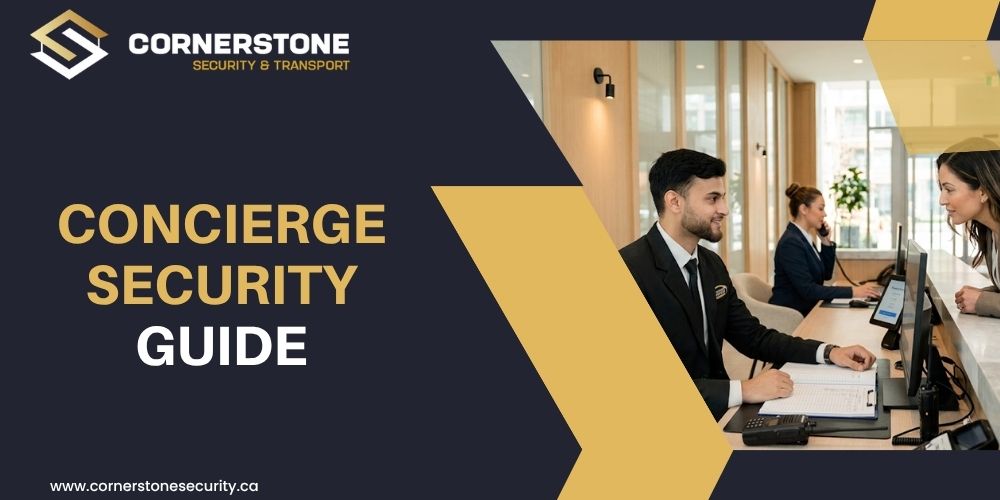
Concierge security pairs a licensed security officer with hospitality-style guest service. The person staffing the front desk or lobby is the same person responsible for access control, visitor screening, package handling, and incident response — trained to run both functions at once rather than splitting them between a receptionist and a guard.
It’s the model you’ll find staffing condominium lobbies, boutique hotels, corporate headquarters, retail flagship stores, and — less commonly, but increasingly — private residences and high-profile individuals who want a hospitality-level front door without giving up real security behind it.
This guide covers what a concierge security officer actually does day to day, how the cost compares to a traditional security guard, whether it’s worth it for a condo board or commercial property, what the licensing requirements actually are in British Columbia, and what to check before hiring a provider.
What Concierge Security Actually Means
The term gets used loosely, so it’s worth being precise about what separates it from a standard guard posting.
A traditional security guard’s default posture is deterrence: patrol the property, check IDs, log incidents, and respond when something happens. The job is built around being visibly present and reactive.
A concierge security officer carries the same licensing and training as a guard, but the default posture is different. The first job is to be the welcoming, informed point of contact for residents, tenants, guests, or employees — greeting people by name, managing deliveries, coordinating amenity bookings, answering questions about the building. Security functions — access control, visitor verification, surveillance monitoring, incident response — sit underneath that, not instead of it.
In practice, that means the role shows up differently depending on where it’s deployed:
- Condominiums and apartment towers — the most common setting, where concierge staff manage resident access, packages, and visitor sign-in alongside building security.
- Boutique and luxury hotels — where guest-facing service and loss prevention sit with the same team.
- Corporate offices and headquarters — reception and access control combined, often the first security layer a visitor encounters.
- Retail flagship locations — customer service and loss prevention under one role.
- Private residences and high-profile individuals — a smaller but growing use case, where the concierge model extends the same hospitality-forward approach to a single household or principal rather than a shared building.
Whoever is at the door is doing two jobs at once, and doing both well takes more training than either job alone. Concierge officers are trained in etiquette and hospitality in addition to standard security duties, and many properties have them wear business attire rather than a uniform for exactly that reason.
Concierge Security vs. Traditional Security Guards
The two roles overlap enough that people use the terms interchangeably. They shouldn’t be.
| Concierge Security | Traditional Security Guard | |
|---|---|---|
| Default posture | Service first, security underneath | Deterrence and patrol |
| Daily focus | Greeting, access control, deliveries, resident/guest requests | Patrol routes, ID checks, incident logging |
| Appearance | Business attire, blends into the property | Uniformed, visibly a guard |
| Training | Standard security licensing plus hospitality/etiquette training | Standard security licensing |
| Armed status | Almost always unarmed | Can be armed or unarmed, role-dependent |
| Best suited for | Residential towers, hotels, offices, retail, private residences | Construction sites, warehouses, perimeter/patrol work |
Neither model is strictly better — they’re built for different problems. A construction site or a vacant warehouse doesn’t need someone trained in guest service; it needs a guard on patrol. A condo lobby, a hotel entrance, or a private residence’s front door usually does need both functions handled by the same person, because splitting “security” and “hospitality” into two separate people at a small property is either redundant or leaves a gap when only one of them is on shift.
What a Concierge Security Officer Does Day to Day
Strip away the branding and the job breaks down into a consistent list of tasks, regardless of property type:
- Greeting residents, tenants, guests, or employees and verifying who belongs on the property
- Managing visitor sign-in and issuing temporary access
- Controlling building access — key fobs, elevator restrictions, gate systems
- Receiving, logging, and securing packages and deliveries
- Monitoring CCTV and alarm systems from the desk
- Coordinating amenity bookings, maintenance requests, or move-in/move-out logistics (property-dependent)
- Conducting periodic walkthroughs of common areas, not just sitting at a desk
- Responding to incidents — medical, disturbance, suspicious activity — and escalating to police or emergency services when needed
- Keeping a written incident log and handing off a clear shift report
The ratio of hospitality tasks to security tasks shifts depending on the property. A hotel concierge security role leans further into guest service; a commercial office lobby leans further into access control and visitor management; a private residence leans toward discretion and routine. The full list above is the baseline a provider should be training to, not picking from.
Is Concierge Security Worth It?
For a condo board weighing a few hundred dollars a month per unit against the alternative — cameras and a phone-entry system with no one physically present — the honest answer is that it depends on the building’s risk profile, not a universal yes or no.
What concierge security reliably adds that technology alone doesn’t:
- A human point of contact: Cameras record; they don’t greet a resident’s late-night guest, intercept a package thief, or de-escalate a dispute in the lobby.
- Faster incident response: Someone already on-site responds in seconds, not after a monitoring centre reviews footage and places a call.
- A deterrent effect that’s visible without feeling hostile: A uniformed guard signals “security.” A concierge signals “someone is paying attention” — often enough on its own to discourage opportunistic issues like package theft or unauthorized access.
- Liability positioning: If an incident happens, a building that documented a trained, licensed security presence is in a stronger position than one relying on cameras alone — insurers and legal counsel both treat “nobody was watching” differently from “someone was there and logged it.”
- Resident and tenant experience: Buildings market concierge service as an amenity for a reason — it affects retention and perceived property value, not just safety.
Where it’s less clearly worth it: very small buildings with low foot traffic, low-risk commercial tenancies, or properties where a monitored alarm system and occasional patrol genuinely covers the exposure.
What the Role Actually Requires
The role is built around presence, documentation, and de-escalation rather than force, and most properties that want a concierge-style front desk don’t want a uniformed presence changing how it feels to walk through the lobby.
Licensing requirements vary by province and state, but in British Columbia, every individual doing paid security work — concierge or otherwise — needs a security worker license under the province’s Security Services Act, which requires completing Basic Security Training, passing a criminal record check, and agreeing to the Act’s code of conduct. A license from another province doesn’t transfer automatically — anyone working in BC needs to be licensed in BC. Armed roles require additional, separate licensing on top of that baseline.
How to Choose a Concierge Security Provider
The gap between a good concierge security company and a mediocre one usually shows up in the hiring and training process. A few things worth checking before signing a contract:
- Licensing and insurance: Ask to see the company’s security business license and proof of liability insurance — not just that individual guards are licensed.
- Screening standards: Background checks, reference checks, and — for anything handling resident or guest information — some evidence of how they vet for discretion.
- Clear reporting: Shift logs, incident reports, and a point of contact for the board or property manager.
- Flexibility in coverage model: The right provider can scale from a single part-time shift to full 24/7 staffing, and can tell you when you don’t need as much coverage as you think.
- References from similar properties: A company that staffs condo towers well isn’t automatically the right fit for a private residence or a retail flagship, and vice versa.
That last point matters more than it looks. The skills that make someone excellent at a 200-unit condo desk — handling volume, routine, and a large resident list — aren’t identical to the skills that make someone right for a single household or a high-profile individual, where the job leans more on discretion and adaptability than throughput.
Concierge Security at Cornerstone
We built Cornerstone’s concierge security offering around a gap we kept seeing in Vancouver: most concierge security companies are set up to staff buildings, and that’s it. We also work with private residences, high-profile individuals, and businesses that need the same hospitality-forward model without a large multi-unit property behind it.
That comes from where the rest of our work sits. Our team’s background is in executive and close protection — the training that goes into protecting a principal rather than patrolling a lot — and we bring that same standard of discretion and planning to concierge roles. For a condo board, that means a trained, licensed team that handles the day-to-day well. For a private residence or a high-profile client, it means a concierge-level front door backed by people who are also trained for executive protection, not a security guard asked to be friendlier.
We cover residential towers, boutique hotels, corporate offices, and retail locations across Vancouver and the surrounding region, and we scale coverage to match the property rather than defaulting every client to 24/7 staffing whether they need it or not. If a site assessment says a building needs eight hours of coverage a day rather than around the clock, that’s what we recommend — not what maximizes the invoice.
Frequently Asked Questions
What’s the real difference between a concierge and a security guard?
Both carry the same base security licensing. The difference is orientation: a guard’s job is built around patrol and deterrence, while a concierge’s job is built around being the welcoming point of contact first, with security functions — access control, monitoring, incident response — running underneath that.
How much does concierge security cost per month?
It depends almost entirely on coverage hours and officer count. A single daytime shift costs a fraction of round-the-clock staffing, and 24/7 coverage for one building can run into the tens of thousands of dollars a month once you factor in multiple officers covering a full schedule. Get a site assessment before budgeting off a general number.
Do concierge security officers need special licensing?
Yes — in British Columbia, anyone doing paid security work needs a provincial security worker license, which requires Basic Security Training, a criminal record check, and compliance with the Security Services Act’s code of conduct. A good concierge provider adds hospitality and etiquette training on top of that baseline, not instead of it.
Can concierge security be set up for a single residence rather than a whole building?
Yes, though fewer providers offer it well. It requires the same licensing and training as building-based concierge work, plus the discretion and adaptability that come from a background in personal or executive protection rather than large-property staffing.
Talk to Cornerstone About Concierge Security
If you’re a condo board comparing coverage options, a property manager planning next year’s security budget, or you’re looking for a concierge-level front door for a private residence, the best starting point is a site assessment rather than a guess. We’ll walk the property, ask about your actual risk and traffic patterns, and recommend a coverage model built around what the building or residence needs — not a default package.
Book a consultation with our team to talk through what concierge security would look like for your property.
— Justice Osei, Founder, Cornerstone Security